Sports physicals in New Jersey: what parents need before the season
Every season starts with the same scramble: a team email goes out, the first practice is two weeks away, and somewhere in the paperwork is a line about a sports physical. In New Jersey, school sports have clear rules about which form to use, who can sign it, and how long it lasts. Getting them right early is the difference between a child on the field at tryouts and a child waiting on the sideline for a signature.
This guide explains what a sports physical is, when a New Jersey student athlete needs one, which forms schools ask for, what happens at the appointment, and how to plan around the season.
What is a sports physical?
A sports physical is formally called a preparticipation physical evaluation, or PPE. It has two parts: a detailed health history that the family fills out, and a focused exam by a clinician. The American Academy of Pediatrics describes the goal as giving athletes the best opportunity for full and safe sports participation, and much of the history focuses on signs of heart problems, past concussions, and mental health (HealthyChildren.org, from the AAP).
It is not the same as an annual well visit, which covers growth, development, vaccines, and general health. Many families combine the two, and the AAP prefers that the PPE be done by the child's own pediatrician, who knows their history (HealthyChildren.org).
In New Jersey, the exam must be done by a licensed physician, advanced practice nurse, or physician assistant who has completed the state's student athlete cardiac assessment training module (NJ Department of Education). Chiropractors cannot complete it (NJDOE FAQ).
When does a New Jersey student athlete need one?
State law requires a physical before any student in grades 6 to 12 plays on a school-sponsored interscholastic or intramural team. The exam must be done within 365 days before the first day of official practice in that athletic season (NJDOE Information for Student Athletes).
Two details trip families up:
- The 90-day update. If the physical was done more than 90 days before the first official practice of a season, the parent also has to fill out a short Health History Update Questionnaire, often called the 90-day form (NJDOE FAQ). A spring athlete with a summer physical will usually need one.
- Mid-season expiration. A student whose physical is current on the first day of the season, tryouts included, is cleared for the whole season, even if the exam passes the one-year mark partway through (NJDOE FAQ).
The form also has to be submitted and approved by the school physician before the student can take part, so a physical done the night before tryouts may not be processed in time. Districts can set their own submission deadlines.
Rec, travel, and club teams outside school are not covered by this law. Many set their own medical rules, so check the registration paperwork for each team.
Which forms do NJ schools ask for?
New Jersey uses the national PPE form, tailored to state law. Since the 2024 update, only one page of the physical goes to the school. The history and exam pages stay with the healthcare provider, and the school gets the PPE Medical Eligibility Form (NJDOE memo, May 2024). The NJSIAA points families to the same Department of Education forms and confirms that the cardiac, opioid, and concussion forms are still required (NJSIAA memo).
All of them can be downloaded from the NJDOE student athlete page:
| Form | Who fills it out | Where it goes | When |
|---|---|---|---|
| PPE History Form | Parent and student | Stays with the provider | Before the appointment |
| Physical Examination Form | Provider | Stays with the provider | At the appointment |
| PPE Medical Eligibility Form | Provider | School | Before the first practice or tryout |
| Health History Update Questionnaire | Parent | School nurse | If the physical is more than 90 days old at the first practice |
| Sudden cardiac death pamphlet sign-off | Student and parent | School | Every year, before participating |
| Opioid fact sheet sign-off | Student and parent | School | Every year, before participating |
| Concussion fact sheet acknowledgment | Student and parent | School | Every year, before participating |
Each acknowledgment has to be signed on its own. One general signature for all of them is not accepted (NJDOE FAQ). Schools also hand out a sports-related eye injury fact sheet. And a parent still has to complete the history form for an 18-year-old student unless the student is legally emancipated.
What happens during the exam?
The history form asks pointed questions, and they are worth answering carefully at home rather than in the waiting room. The New Jersey version asks whether the athlete has ever:
- Passed out or nearly passed out during or after exercise
- Had chest pain, tightness, or pressure during exercise
- Felt their heart race, flutter, or skip beats during exercise
- Had a concussion or head injury
It also asks whether any relative died of heart problems or an unexplained sudden death before age 35, and includes four short questions about anxiety and mood (NJ PPE History Form). If your child has been struggling with nerves around sports, our guide to sports anxiety in kids may help you talk about it.
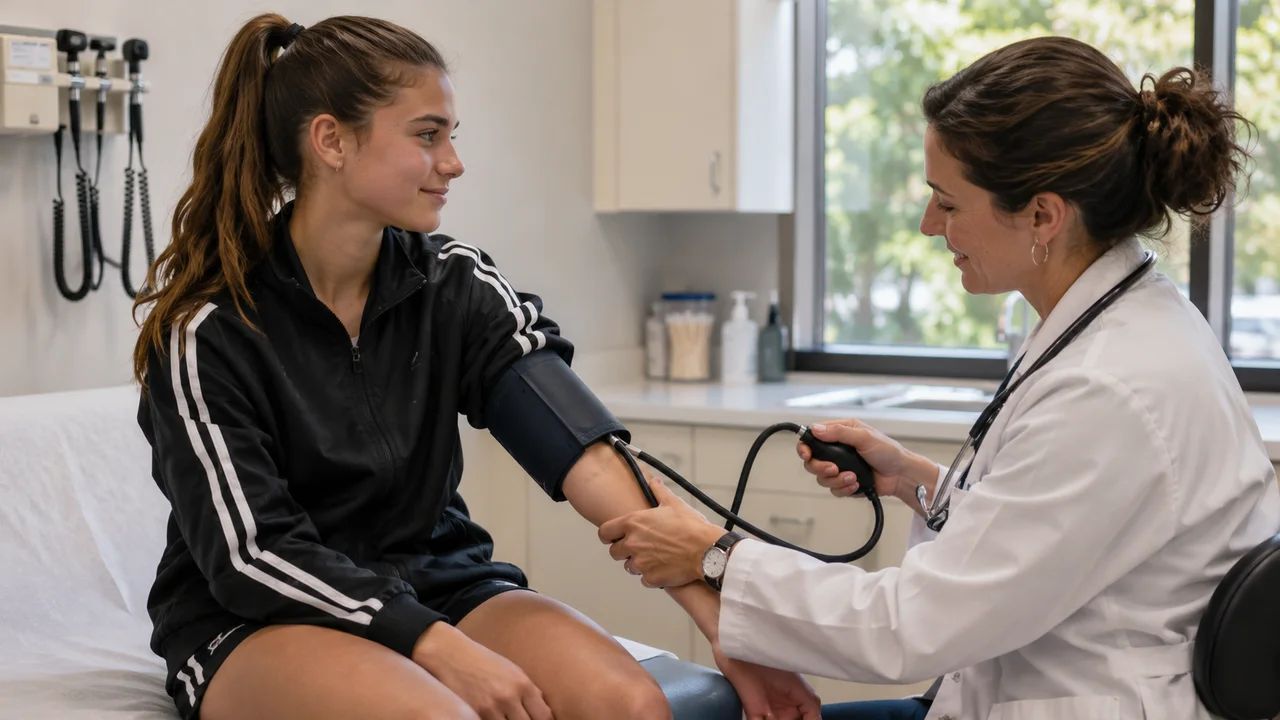
The exam itself covers height, weight, blood pressure, pulse, and vision, then a check of the heart and lungs, skin, and the joints from neck to ankle (NJ PPE Physical Examination Form).
The provider then marks one of five outcomes on the eligibility form: eligible for all sports without restriction, eligible with recommendations for further evaluation or treatment, eligible for certain sports, not eligible pending further evaluation, or not eligible for any sports (NJ PPE Medical Eligibility Form). According to the AAP, most athletes are cleared without restriction, and most of those referred for a closer look, for example to a pediatric cardiologist, are still cleared (HealthyChildren.org).
How to prepare and when to book
- Book 6 to 8 weeks ahead. That is the AAP's advice, and it leaves time for any follow-up before the season (HealthyChildren.org).
- Fill in the history form at home. Bring a list of current medicines and supplements, allergies, past surgeries, and injury notes.
- Bring the New Jersey form. The school needs the state's Medical Eligibility Form, which includes the provider's signed cardiac module certification.
- Keep copies. Photograph the eligibility form before handing it in, and note the exam date so you know when the 90-day update applies.
Common mistakes: the wrong form, a missing parent signature on one of the acknowledgments, and a physical that is just over a year old on the first day of practice.
Planning around the New Jersey seasons
The date that matters is the first official practice. For 2026-27, the NJSIAA lists November 30, 2026 as the first day of basketball practice, with an optional tryout window of November 23 to 25 (NJSIAA winter quick chart), and March 8, 2027 as the first day of softball practice (NJSIAA spring quick chart). All dates are listed as tentative. Count back 6 to 8 weeks from your child's first practice, and if they play more than one season, check whether a single physical covers all of them with 90-day updates.
If your child also trains with a private coach, ask one question at the first session: what do you need to know about my child's health before we start? A good coach will ask about recent injuries, asthma, allergies, and anything the doctor flagged, and will adjust the session to match. You do not need to share the whole form, just what affects training.
When the paperwork is done, you can find coaches in every sport from the Rite Coach home page, or start with basketball coaches in New Jersey ahead of the winter season. Our guide on how to choose a youth sports coach covers what to ask.
Frequently asked questions
How long is a sports physical good for in New Jersey?
For school sports, the exam must be within 365 days of the first official practice of the season. If it is more than 90 days old at that point, a Health History Update Questionnaire is also required.
Can an urgent care clinic do a school sports physical?
It can, if the clinician is a licensed physician, advanced practice nurse, or physician assistant who has completed the state cardiac assessment module and uses the New Jersey form. The AAP prefers the child's own pediatrician, who knows their history.
Do rec and travel teams need a physical?
The state rule covers school teams in grades 6 to 12. Rec, travel, and club teams set their own requirements, so check each team's registration paperwork.