Private vs. Group Sports Training: Which Is Right for Your Child?
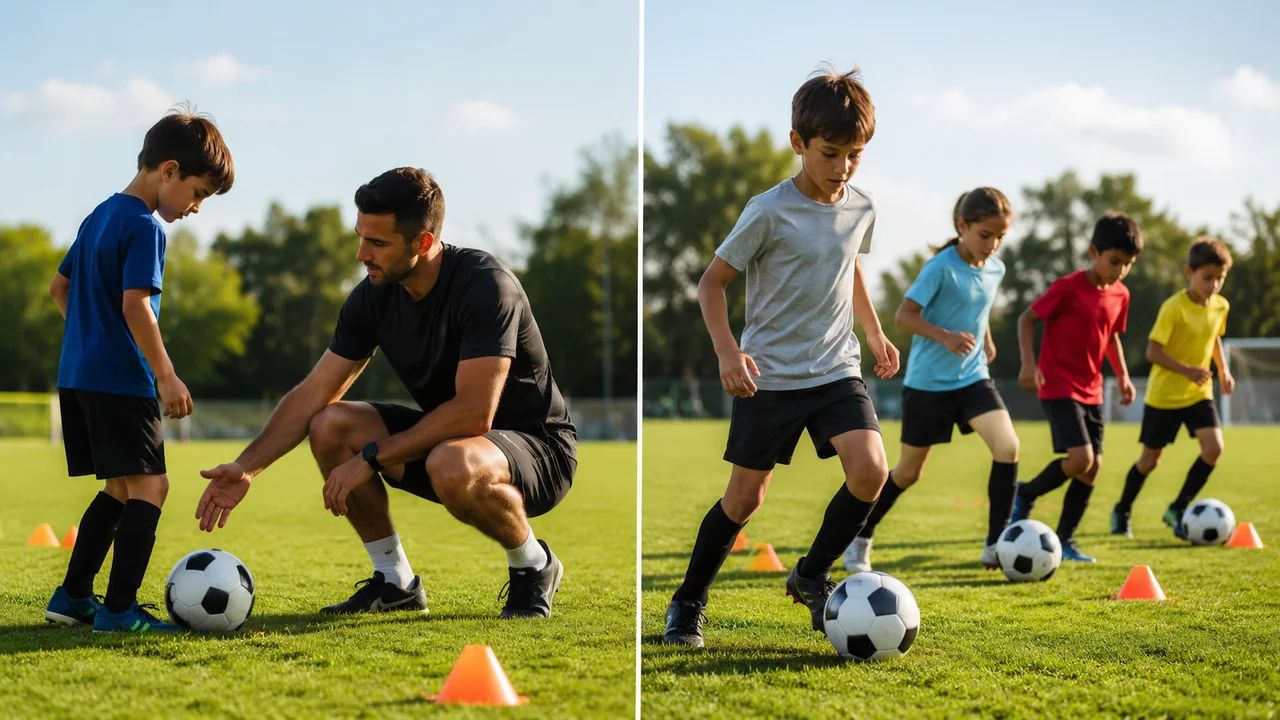
When you decide to invest in coaching outside of team practice, one choice comes up immediately: one-on-one private sessions, or small-group training? Both work. They simply fit different children, different goals, and different budgets, and the wrong choice usually shows up as a child who is bored or a parent who feels they overpaid.
Here is how to decide.
Private, One-on-One Training
Best for: rapid skill correction, tryout preparation, shy children who freeze in a crowd, or one specific weakness you want fixed quickly.
The defining feature is uninterrupted feedback. A coach watching one player can correct a shooting elbow or a first touch on every single repetition, which is what makes technical change happen fast. In a group, even a small one, a child gets a correction every third or fourth rep, and mechanical habits need more than that to shift.
Pros:
- All of the coach's attention, on every repetition.
- The session is built entirely around your child's goal.
- Fastest progress on a specific, identifiable skill.
- Easier for anxious or self-conscious children, who often will not attempt something new in front of peers.
Cons:
- Costs more per session than sharing a coach.
- Less of the game-like competition many children need to stay engaged.
- An hour of undivided attention is intense, and some younger children fade before it ends.
Small-Group Training
Best for: children who thrive on competition, friends or siblings training together, and families who want strong coaching at a lower price per child.
Groups of two or three are the sweet spot. Beyond four, it starts behaving like a team practice and the individual attention you were paying for disappears.
Pros:
- Lower cost per child, since several families share the hour.
- Built-in competition and game-realistic repetitions.
- Social, which keeps many children engaged for longer.
- Better for anything that needs opposition: defending, finishing under pressure, one-on-one situations.
Cons:
- Attention is shared, so technical corrections land less often.
- Progress on one specific weakness is usually slower.
- Only works if the children are at a broadly similar level. A large gap frustrates everyone.
What It Actually Costs
The economics are the part most families underestimate. Coaches listed on Rite Coach in New Jersey generally charge between $50 and $85 an hour for private sessions. Split that hour between three players and the cost per family drops to roughly a third, which is what makes a weekly commitment realistic for a lot of households.
The practical consequence: many families can afford weekly small-group training but only monthly private sessions. Weekly beats monthly for almost every goal, so if budget is the constraint, a group session every week is usually a better investment than a private one every four.
How to Set Up a Small Group
Most coaches do not maintain a waiting list of children looking for group partners, so if you want a group you usually have to build it. It is easier than it sounds.
Start with your child's own team. A teammate at a similar level is the ideal partner, because you already know the parents, the schedules overlap, and the children are used to each other. Two families is enough. Three is better value and still keeps the attention high.
Match on level rather than friendship where you can. Two children who are close friends but a year apart in ability will drift, and the stronger one coasts while the weaker one hides. A coach will usually tell you honestly whether a pairing works after one session.
Agree the money before the first session. Decide who pays the coach and how the others reimburse them, and settle what happens when one child cannot make it, because that will come up by week three. The simplest rule most families use: the session runs and the cost splits the same way regardless of who attends, which keeps it predictable and stops the group falling apart.
Finally, ask the coach before assuming. Not every coach runs groups, and some price them per session rather than per player, which changes the numbers entirely.
How to Choose
- Fixing a specific problem or preparing for tryouts? Go private. You are buying correction rate, and that is what one-on-one delivers.
- Want value, competition, and a social setting? Go small-group.
- Child is nervous or new to the sport? Start private. Confidence is easier to build without an audience, then a group becomes enjoyable rather than exposing.
- Child gets bored easily or is highly competitive? Go group. They will work harder against someone than against a cone.
- Not sure? Many families start with two or three private sessions to build a foundation and let the coach identify what needs work, then move to a group to keep costs down and add competition.
Either Way, the Coach Matters Most
Format is secondary to whether the coach fits your child's age, level, and personality. A good coach in the wrong format still helps. A poor fit in the right format does not.
Ask a coach directly which they would recommend for your child, and treat the answer as information about the coach. Someone who asks about your child's level, temperament, and goal before answering is a better bet than someone who recommends whichever format they happen to sell.
On Rite Coach you can compare coaches across New Jersey by experience, rates, session formats, and parent reviews, then message them directly. Find a coach near you.
Bottom Line
Private training buys speed and focus. Group training buys value and competition. Match the format to your child's goal and temperament, and choose the coach even more carefully than the format.