Basketball conditioning drills for youth players
Every winter, New Jersey gyms fill with the same sound: a whistle, sneakers on the baseline, and a groan as the running starts. Basketball conditioning drills have a reputation as punishment, but done well they are why a player can still defend, finish, and make free throws in the fourth quarter. The best ones look a lot like basketball.
This guide covers what makes basketball fitness different, how much suits each age, the drills worth doing, and a 20-minute block to run before tryouts. For ball handling, passing, and footwork, start with our main guide to basketball drills for kids.
Why is basketball conditioning different?
Basketball is not a distance sport. A possession is a burst of sprinting, stopping, cutting, and jumping, followed by a few seconds of walking, a free throw, or a timeout. A player who jogs three miles a day can still be gassed by the second half, because steady jogging trains a different kind of fitness.
What players need is repeat sprint ability: going hard, recovering quickly, and going hard again, in the fourth quarter as well as the first. That means:
- Short, hard efforts with planned rest, so the next rep is fast too.
- Changes of direction. Stopping, cutting, and sliding tire legs in ways straight-line running does not.
- A ball whenever possible. It keeps kids engaged and trains what decides close games: clean passes and finishes while tired.
How much conditioning should kids do at each age?
- Ages 8 to 10. Fitness comes from play. Tag games, dribble relays, and small-sided games get kids breathing hard without anyone calling it conditioning. Skip timed punishment runs entirely.
- Ages 11 to 13. Short timed shuttles and relays with full recovery, once or twice a week, at the end of a skills session.
- Ages 14 and up. Structured intervals, plus a short preseason block in the weeks before tryouts.
Rest matters at every age. The American Academy of Pediatrics advises one to two rest days a week and at least two to three months off from a sport each year, and says kids should not train more hours each week than their age (HealthyChildren.org, from the AAP). That total includes practice, games, private sessions, and extra running at home. The AAP has also cautioned that specializing in one sport too early can carry physical and psychological costs (AAP clinical report).
Watch growth spurts, too. Osgood-Schlatter disease causes pain and swelling at the bony bump just below the kneecap, most often during growth spurts in running and jumping sports (OrthoInfo, AAOS). Sever's disease is an irritation of the growth plate at the back of the heel, also most common during growth spurts (OrthoInfo, AAOS). Both usually settle with rest and end once a child stops growing, but a player with knee or heel pain should sit out sprints and see a doctor rather than run through it.
Full-court basketball conditioning drills with a ball
Reach for these first, because every rep builds skill as well as fitness.
Continuous full-court layups
Dribble the length of the floor, finish a layup, rebound, and go straight back for a layup at the other end: right hand one way, left hand coming back. Go for 45 seconds and count makes. Older players only count layups finished with the correct hand.
Three-man weave to a sprint back
Three players weave up the floor, passing and running behind the player they passed to, and finish with a layup. The moment it goes in, all three sprint back past half court as if getting back on defense. It trains passing on the move and the transition habit coaches want.
Speed dribble down and back
Speed dribble baseline to baseline with the right hand, then back with the left, pushing the ball out in front. When that gets easy, the timed full-court ball handling course in our hub guide adds a move at each mark and makes a good fitness test.
Mikan drill as an active cooldown
The Mikan drill, alternating layups under the basket, is explained in the same guide. It fits the end of a block because heart rates come down while players keep working on touch.
Sprint drills, done right
Running without a ball still has a place, mostly for players 14 and older. What separates useful sprints from punishment is the rest.
Line drills (suicides). From the baseline, sprint to the free throw line and back, half court and back, the far free throw line and back, and the far baseline and back. Run timed reps with a set rest, not nonstop until someone quits. When times drop off sharply, the set is over.
Sideline 17s. Sprint sideline to sideline 17 times against a target time the coach sets. It is a hard drill for older high school players only, used sparingly.
How much rest? Human Performance Resources by CHAMP (HPRC) at the Uniformed Services University puts short, full-speed sprint training at a work-to-rest ratio of about 1:3 to 1:8, so a 10-second sprint earns roughly 30 to 80 seconds of recovery (HPRC). For youth players, stay at the longer end. Treat this table as a starting point:
| Drill | Reps | Work to rest | Best age group |
|---|---|---|---|
| Dribble relays | 3 to 4 rounds | Rest while teammates go | 8 to 10 |
| Baseline sprint (about 5 seconds) | 6 to 8 | 1:6 to 1:8 | 11 and up |
| Continuous layups (45 seconds) | 3 to 4 | 1:3 | 11 and up |
| Defensive slides (15 to 20 seconds) | 4 to 6 | 1:3 to 1:4 | 11 and up |
| Line drill (about 30 seconds) | 3 to 5 | 1:3 to 1:4 | 14 and up |
| Sideline 17s | 2 to 3 | 1:3 or more | Older high school |
Defensive and lateral conditioning
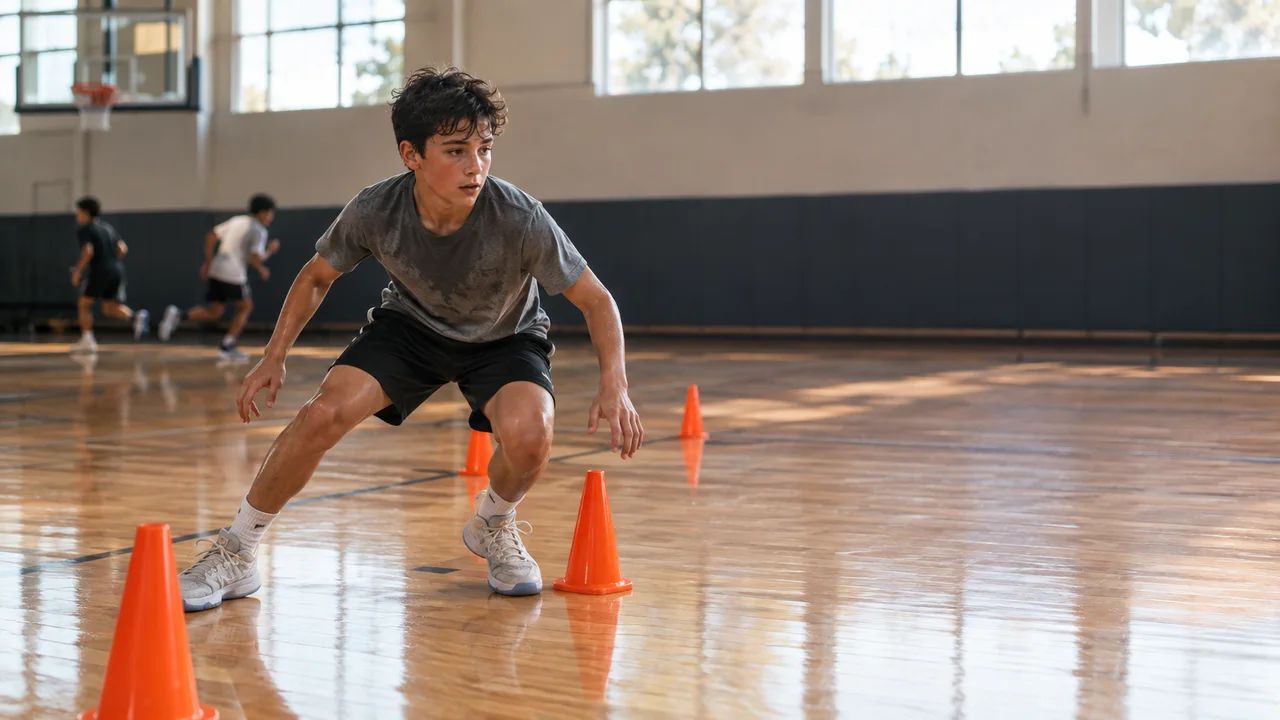
- Lane line slides. Slide lane line to lane line in a low stance, pushing off the trailing foot, never crossing the feet. Go 15 to 20 seconds, counting touches.
- Closeout and slide. Sprint from under the basket to a cone on the wing, chop the feet with a hand high, then slide back to the baseline.
- Partner mirror. An offensive player moves side to side inside the lane while a defender mirrors every step for 15 to 20 seconds, then swap. Kids push harder against a partner than in plain slides.
A sample 20-minute conditioning block
Run this at the end of a skills session, two or three times a week for high schoolers in preseason and once or twice for middle schoolers.
- Dynamic warm-up, 5 minutes. Skips, walking lunges, high knees, side shuffles, and a few easy build-up runs.
- Rotating stations, 10 minutes. Continuous layups, lane line slides, closeout and slide, and speed dribble, about two and a half minutes each, using the rest guidance above.
- Free throws while tired, 5 minutes. Sprint baseline to baseline, then shoot two. Track makes, since late-game free throws come on tired legs. Our basketball shooting drills guide covers form.
Common mistakes: running as punishment, conditioning before skill work (tired players practice sloppy mechanics), skipping water breaks, and ignoring knee or heel pain.
Timing it to the New Jersey season
For high school players, the NJSIAA sets the calendar. Its winter quick chart lists November 30, 2026 as the first day of basketball practice for 2026-27, with games allowed from December 7 once a team meets the rule of six days of practice and one day of rest. Schools may also hold an optional three-day tryout on the Monday through Wednesday before Thanksgiving, November 23 to 25 this year (NJSIAA; all dates are listed as tentative). Many town rec leagues and travel programs start winter seasons around the same time, so October and November are the preseason window.
If your child works with a private trainer, ask one question before tryouts: how do you fit conditioning into a skills session without cutting shooting reps? Good answers usually put the ball into the conditioning, with layup chains and closeouts that end in a shot, and save pure running for the last few minutes.
If you would like help building that plan, compare private basketball coaches in New Jersey on Rite Coach by experience and the ages they train, then contact them directly. For what shapes the cost, see our guide to private basketball lesson costs in New Jersey.
Frequently asked questions
How often should youth basketball players do conditioning?
Middle schoolers do well with one or two short sessions a week after skill work. High schoolers can do two or three in the weeks before tryouts, keeping one to two full rest days a week.
Are suicides bad for kids?
Not on their own. The problems come from using them as punishment, running them without rest, and giving them to players too young for them.
Should my child run on their own before tryouts?
Short sessions a few times a week help, ideally with a ball. Daily hard running on top of other sports is more likely to leave them sore than ready.
Looking for a private basketball coach?
Rite Coach lists coaches across New Jersey.