How to get better at soccer: 12 habits that work at any age
If your child wants to know how to get better at soccer, the honest answer is less about talent than about touches. Team practice has to share one coach, a handful of balls and an hour or so between fifteen or more players, so each child gets a limited number of real repetitions. The players who pull ahead are usually the ones who add a little work of their own between sessions.
The twelve habits below are what that extra work looks like. Most need only a ball, a wall and fifteen minutes.
Why do some players improve faster than others?
Everyone on a team runs the same drills. The difference is what happens on the other days: the player who kicks a ball against the garage door every evening has had hundreds of extra touches by the end of the month.
One rule before you start: do not hand your child all twelve habits at once. Pick two or three for a month, make them routine, then add another.
How to get better at soccer on the ball: habits 1 to 4
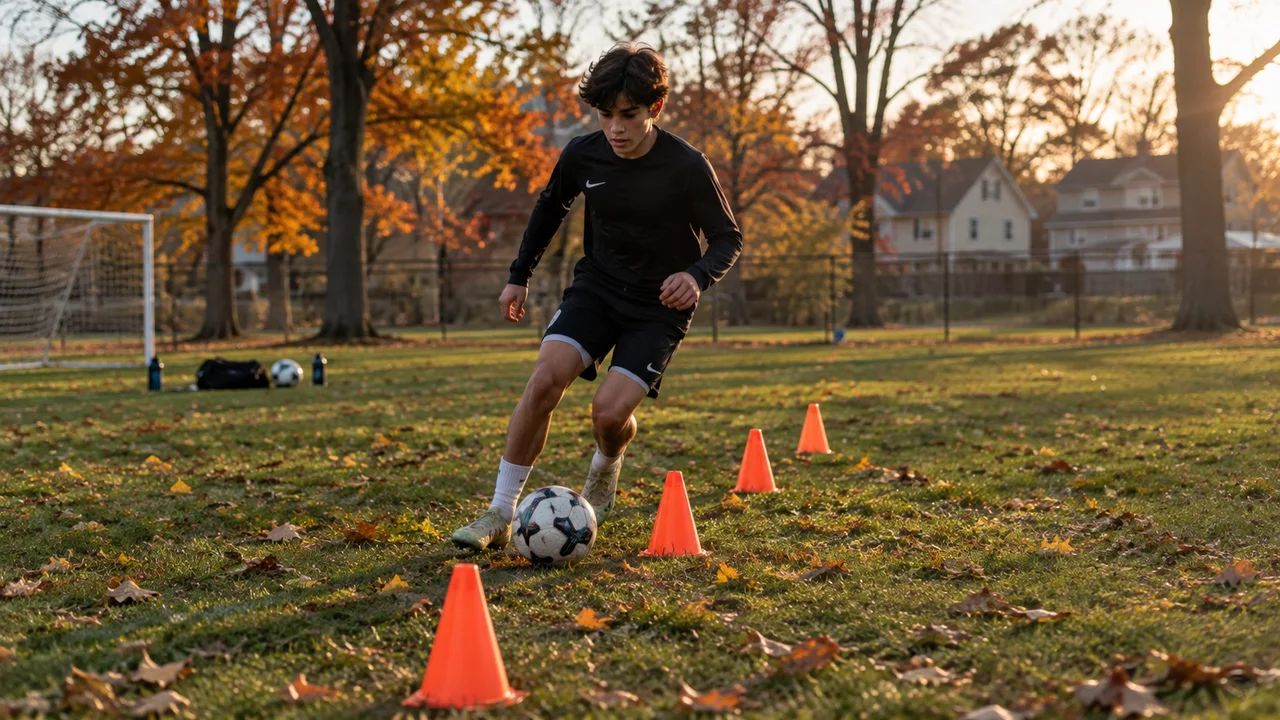
1. Ten to fifteen minutes of ball mastery most days
Sole rolls, toe taps, inside and outside touches, pull backs. These small, fast movements build the feel for the ball that everything else depends on. Ten minutes on five days a week does more than one long session on Sunday.
2. Wall passing with both feet
A wall is the most patient training partner there is. Pass, receive, pass again, alternating feet. Once that is comfortable, add a rule: the first touch has to move the ball away from an imaginary defender, to one side, before the next pass.
3. One weak-foot session a week
Choose one day where the weaker foot does everything: dribbling, passing, juggling, shooting. Players who can use both feet are much harder to defend, and most young players avoid the weak foot entirely in team settings.
4. Juggling as a touch test
Juggling is not a game skill in itself, but it is an excellent measure of touch. Keep a written record and try to beat it each week. The number gives your child something concrete to chase, and it shows both of you whether the work is paying off.
Think like a player: habits 5 to 8
5. Scan before the ball arrives
Good players look over their shoulder before they receive, so they already know where the space and the pressure are. Build it into every passing drill at home: before each pass comes back, your child glances left and right.
6. Watch one match a week, and follow one player
Instead of following the ball, pick a professional who plays your child's position and watch only them for twenty minutes. Where do they stand when their team has the ball?
7. Play pickup, small-sided games and futsal
Drills build technique. Games build decisions. Small-sided games give each player far more touches and choices than a full-size match, which is why US Soccer's youth standards use 4v4 for U8 and younger, 7v7 for U9 and U10, and 9v9 for U11 and U12 (Eastern Pennsylvania Youth Soccer summary of the US Soccer standards). In winter, futsal, played indoors with a smaller, heavier ball, keeps the touches coming when fields are cold or closed.
8. Ask the coach for one thing to work on
Encourage your child, not you, to ask the team coach each week: "What is one thing I should work on?" Write the answer down and make it the focus of that week's home practice. It keeps practice pointed at real gaps.
Body and mindset: habits 9 to 12
9. Short speed and agility work, plus real rest
Quick feet, short sprints and changes of direction help at every age. Keep them to about ten minutes. Just as important is rest. The American Academy of Pediatrics advises families to plan one to two days of rest every week and at least two to three months off from a single sport across the year, which can be split into one-month breaks (HealthyChildren.org, from the AAP). The same page suggests kids should not train more hours each week than their age.
10. Sleep, water and food around games
Recovery happens off the field. Sleep guidelines supported by the AAP call for nine to twelve hours a night for children aged 6 to 12 and eight to ten hours for teenagers (American Academy of Sleep Medicine consensus statement). For drinks, the AAP says to make sure kids drink water before, during and after practices and games, and that electrolyte drinks may be needed only when vigorous exercise runs past an hour in a day (HealthyChildren.org).
11. A two-minute review after every game
On the drive home, once emotions have settled, ask two questions: what is one thing that went well, and what is one thing to work on? Let your child answer. It turns every game into information rather than a verdict.
12. Play other sports and take breaks from soccer
It sounds backwards, but stepping away helps. The AAP's clinical report on sports specialization says delaying a single-sport focus until late adolescence lowers the risk of overuse injuries and burnout (Pediatrics, 2016). A season of something else builds different movement skills and keeps soccer fun.
What should practice at home look like by age?
| Age group | Focus | Time at home |
|---|---|---|
| U6 to U8 | Fun first. A ball for every child, dribbling games, 1v1 with a parent or sibling. Team games at this age are small, usually 4v4. | About 10 minutes a day |
| U9 to U12 | Both feet, first touch, passing against a wall, scanning. Games move up to 7v7 and then 9v9, so passing and positioning start to matter. | 15 to 20 minutes, most days |
| U13 and up | Position-specific work, fitness, and understanding tactics on the full-size field. | Planned around the team schedule, with rest days kept |
For specific drills at each stage, see our guide to youth soccer drills by age.
A habit plan for the New Jersey soccer year
New Jersey's calendar gives each season a natural focus. Town recreation leagues and many clubs play in fall, from early September into November, and high school soccer is a fall sport too: the NJSIAA state finals for 2026 are scheduled for November 21 and 22 (NJSIAA soccer tournament regulations). Winter is futsal and indoor season, with several New Jersey programs running from December through February (Mommy Poppins), and the outdoor spring season follows.
- Fall: the post-game review (habit 11) and asking the coach for one focus (habit 8).
- Winter: ball mastery and weak-foot work (habits 1 and 3), plus futsal or a second sport.
- Spring: wall passing, scanning and pickup games (habits 2, 5 and 7) as fields open up.
Common mistakes to avoid
- Only practicing with the strong foot.
- Drilling with no pressure or decisions. Skills learned without a defender or a choice often fall apart in games. Add a rule, a timer or a parent playing defense.
- Too many hours and no rest days. That is how overuse injuries and burnout start.
- Coaching from the sideline. During games, let the coach coach. Save feedback for the two-minute review.
When a private coach can help
Home practice repeats whatever habits a player already has, including the wrong ones. A few sessions with a private coach can spot a problem with first touch or striking technique and give your child a home routine that fixes it. If you are weighing the options, our guides on private vs group training and what a private soccer coach costs in New Jersey are a good place to start.
When you meet a coach, ask a simple question: "What is the one habit my child should do at home this month?" You can compare private soccer coaches in New Jersey on Rite Coach by experience, the ages they train and parent reviews, then contact them directly.
Frequently asked questions
How long should a kid practice soccer at home each day?
About ten minutes a day is plenty for children under eight. Players from around nine to twelve can handle fifteen to twenty minutes. Consistency matters more than length, and rest days still count.
Can my child get better at soccer without a team?
Yes, for technique. Ball mastery, wall passing and juggling all work alone. Decision-making needs other players, so pickup games, futsal or a team season should be part of the mix.
Is it too late to get better at soccer at 13 or 14?
No. Many players improve the most in their early teens, when they can practice with real focus. Pick two habits from this list, stick with them for a month, and build from there.
Looking for a private soccer coach?
Rite Coach lists coaches across New Jersey.