Soccer passing drills for kids and teens
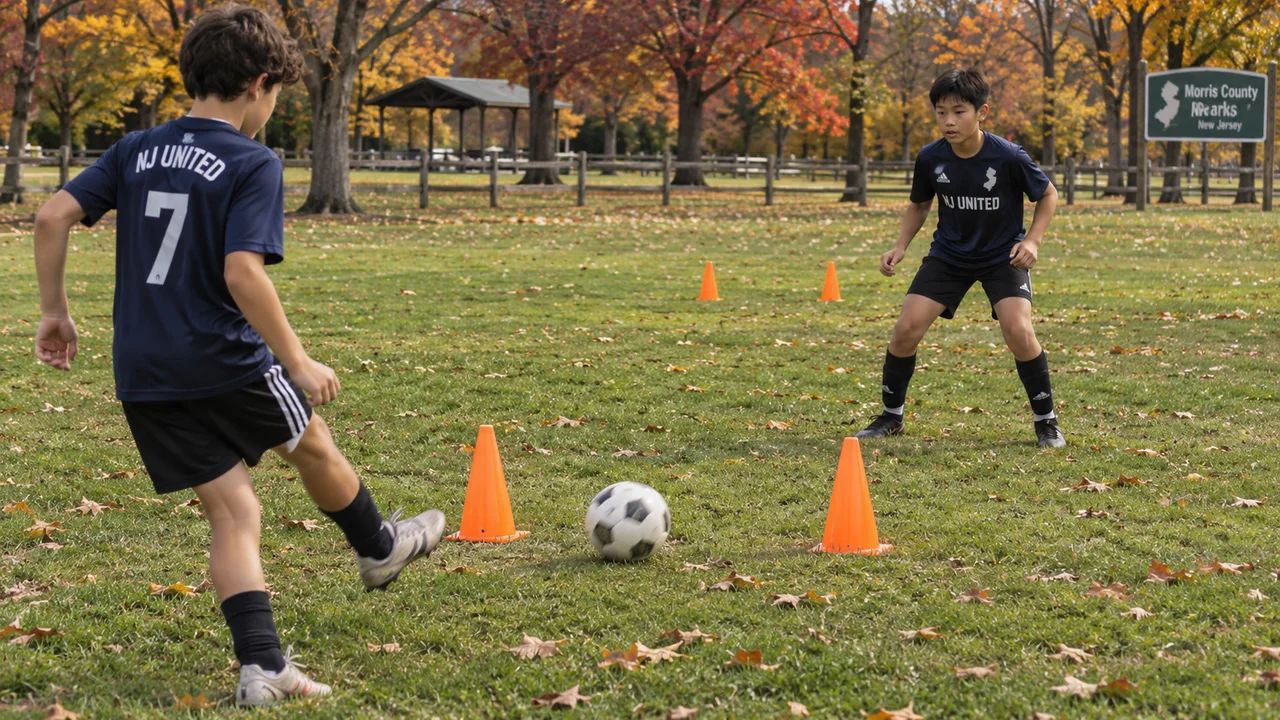
Watch a youth soccer game and count how often the ball changes teams because of a pass that was too soft, too hard, or aimed at the wrong foot. It happens constantly, and it is rarely about talent. Passing is a skill built from a few simple habits, repeated until they hold up when a defender is closing in.
This guide covers the technique cues that make a pass reliable, eight soccer passing drills sorted by age, a game to end practice, and a short routine for home. For drills across every skill at each stage, start with our main guide to youth soccer drills by age.
What makes a good passing drill?
A good passing drill has three things: lots of touches for every player, some kind of pressure or target, and one clear coaching point.
Before the drills, teach the basic push pass with the inside of the foot:
Plant foot beside the ball, pointing at the target. The standing foot aims the pass.
Ankle locked, toes up. The inside of the foot becomes a flat, firm surface.
Strike the middle of the ball. Hitting under it lifts the pass; hitting the top makes it bobble.
Follow through toward the target. The kicking foot finishes pointing where the ball should go.
Receiving is half of passing. A player who stands square and lets the ball hit their feet will need two or three touches to play the next pass. Teach an open body shape (hips half turned so they can see more of the field) and a first touch away from pressure, into space and toward where they want to go next.
Passing drills for ages 6 to 9
Younger players need simple setups, a ball for every pair, and a score to chase.
1. Partner passing, both feet
Partners stand about 5 to 8 yards apart and pass back and forth, alternating feet every pass. When the passes are clean, move to one touch: the receiver passes straight back without stopping the ball. Count how many passes a pair makes in 60 seconds without a miss.
2. Passing gates
Scatter pairs of cones around a grid as small gates, each about a yard or two wide. Partners move around the grid and score a point every time they pass through a gate to each other. They cannot use the same gate twice in a row. It teaches accuracy and looking up, and it feels like a game, not a drill.
To make either drill harder, shrink the gates or add one defender who tries to block passes.
Passing drills for ages 9 to 12
From U9, U.S. Soccer's small-sided format moves to 7v7 with goalkeepers (U.S. Soccer Player Development Initiatives). Bigger fields mean more space to pass into, so drills should start teaching movement as well as technique.
3. Triangle passing with a check run
Three players stand on cones about 10 yards apart in a triangle. Player A passes to B and follows the pass to B's cone. Before receiving, each player takes two quick steps away from the cone and then checks back toward the ball, the way they would lose a defender in a game. Switch direction every two minutes so both feet get used.
4. Diamond passing to space
Add a fourth cone to make a diamond. Now the passer can choose: pass to a teammate's feet, or into the space in front of a teammate who is moving. The coaching point is simple: if a teammate is running, pass where they are going, not where they are.
5. Wall pass and give-and-go
Place a cone or mannequin as a defender. The player with the ball dribbles at it, passes to a teammate standing beside it, and sprints past the defender to receive the return pass on the other side. The two things to coach are timing (pass when the defender is about two yards away) and the run (go behind the defender right after passing).
When it is smooth, make it live: a 2v1 toward a small goal, where the attackers can only score after a give-and-go. Our guide to soccer shooting drills covers the finish.
Rondos for older players
A rondo is a keep-away game: a group of players around the outside of a grid tries to keep the ball from one or two defenders in the middle. The hub guide introduces the 4v1 and 5v2 setups; here is how to size and condition them. No federation publishes official rondo dimensions. Make the grid bigger if the defenders win the ball every few seconds, and smaller if the outside players keep it forever.
| Age | Setup | Grid to start | Rule to add |
|---|---|---|---|
| 9 and 10 | 4v1 | About 10 x 10 yards | Unlimited touches, then three touch |
| 11 and 12 | 4v1 or 5v2 | About 10 to 12 yards square | Two touch |
| 13 and up | 5v2 or 6v2 | About 12 to 15 yards square | Two touch, split passes count double |
Two rules build the right habits. A two touch limit forces a clean first touch. A split pass, played between the two defenders, can count double, which rewards players who look for the forward option instead of passing safely around the outside. Rondos also train scanning: players who glance around before the ball arrives always seem to have more time.
A passing game to end practice
Finish with an end zone game. Play 4v4 on a small field with a five-yard end zone across each end instead of goals. A team scores when a player passes to a teammate who receives the ball inside the end zone. Dribbling into the zone does not count.
It forces players to look up, time their runs, and pass into space, because a pass to a standing teammate is easy to defend.
How to practice passing at home
A wall, a garage door, or a rebounder is all a player needs. Try this 10-minute routine three or four times a week:
Two touch, right foot, 2 minutes. Control, then pass back to the wall from 5 to 8 yards.
Two touch, left foot, 2 minutes.
One touch, alternating feet, 3 minutes.
Move and pass, 3 minutes. Take the first touch to one side, then pass. Switch sides each time.
Set one simple weekly goal: the number of clean left-foot passes (or right, for a left-footed player) in a row. Write it down. The weaker foot is where most young players have the most to gain. For more habits like this, see how to get better at soccer.
Common passing mistakes
Flat-footed receivers. Players who stand still are easy to mark. Stay on the balls of the feet and check toward the ball.
Toes down on a push pass. The ball skids off the foot. Lock the ankle with the toes up.
Passing to feet when space is open. If a teammate is running, lead them.
Only using the strong foot. Build the weaker foot into every drill.
Passing practice through the New Jersey year
High school soccer in New Jersey is a fall sport, and the NJSIAA state finals for 2026 are scheduled for November 21 and 22 (NJSIAA soccer tournament regulations). Town and club fall seasons usually wind down around the same time, which makes winter a good stretch for passing work. Plenty of New Jersey clubs and indoor facilities run futsal and indoor sessions over the winter, and tight spaces reward exactly what this guide teaches: a clean first touch, a quick pass, and moving after it.
If your child works with a private coach, try this at the first session: ask the coach to watch your child receive a few passes and name one first-touch fix. A good coach will spot it quickly, whether it is body shape, the receiving foot, or where the first touch goes, and give your child one thing to practice at home.
You can compare private soccer coaches in New Jersey on Rite Coach by experience and the ages they train, then contact them directly. For what shapes the cost, see our guide to private soccer coach costs in New Jersey.
Frequently asked questions
What is the best passing drill for beginners?
Partner passing with both feet, then passing gates. Both give every child dozens of touches, and gates add a target that keeps it fun.
At what age should kids start rondos?
Most players are ready for a simple 4v1 rondo around 9 or 10, once they can pass and receive with some control. Younger kids get more from partner and gate games.
How can my child pass the ball harder?
Firm passes come from a locked ankle, a plant foot beside the ball, and a follow-through toward the target, not from swinging the leg harder. Practicing against a wall at home builds it quickly.
Looking for a private soccer coach?
Rite Coach lists coaches across New Jersey.