How to jump higher: a safe plan for young athletes
Almost every young athlete wants to jump higher, whether it is to touch the rim, win a header, or get up for a rebound. Jumping is a trainable skill, but the fastest route for a kid or young teen is not a viral vertical program or a pair of ankle weights. It is learning to land, getting stronger, and adding jumps a little at a time.
This guide covers what makes someone jump higher, what experts say about jump training for kids, the vertical jump exercises worth doing, and a six-week plan. For conditioning that pairs well with it, see our guide to basketball conditioning drills.
What actually makes you jump higher?
A jump looks simple, but three things decide how high it goes:
- Strength. Stronger legs and hips can push harder into the ground.
- Speed of force. Being strong is not enough. A good jumper produces that force fast, in the fraction of a second their feet are on the floor.
- Technique. A quick dip before takeoff (the countermovement), a full arm swing, and, for running jumps, a good approach step all add height for free.
For younger kids, technique and coordination usually bring the biggest gains, because they are still learning how to use the strength they have. Older teens gain more from adding real strength.
Parents should also know that jumping can get worse for a while during a growth spurt, as legs lengthen before coordination catches up. That is normal, and it passes. It is a good reason to measure progress over months, not weeks.
Is jump training safe for kids?
Yes, when it is supervised, sensibly progressed, and matched to the child. The American Academy of Pediatrics says children of all ages can benefit from resistance training with proper supervision, and notes that children as young as 5 can build strength with one-legged hops or frog jumps (HealthyChildren.org, from the AAP). The full AAP clinical report stresses proper technique, a dynamic warm-up, and a cool-down (AAP clinical report, Pediatrics 2020).
The 2014 international consensus on youth resistance training, endorsed by both the AAP and the National Strength and Conditioning Association (NSCA), adds a few useful points (Lloyd and colleagues, British Journal of Sports Medicine):
- A child is ready when they are mature enough to accept and follow directions and have good balance and body control. Age alone does not decide it.
- Technique comes first. Harder exercises are added once the basic ones are done well.
- Ordinary jumping and landing can put forces of about five to seven times body weight through the body, which is why learning to land well matters so much.
Pain is the line not to cross. Osgood-Schlatter disease causes pain and swelling at the bony bump just below the kneecap, most often during growth spurts in running and jumping sports (OrthoInfo, AAOS). Sever's disease is an irritation of the growth plate at the back of the heel, also most common during growth spurts (OrthoInfo, AAOS). If your child has knee or heel pain, stop the jump work and see a doctor rather than training through it.
Step 1: learn to land
Every safe jump program starts here, and most kids skip it. A good landing is quiet, balanced, and controlled:
- Land softly on the balls of the feet, then let the heels settle.
- Bend the knees and push the hips back, like starting to sit in a chair.
- Keep the knees pointing over the toes. Knees caving inward is the habit to fix first.
- Hold the landing for two seconds without wobbling.
Two drills teach it. Snap-downs: stand tall on the toes with arms up, then drop quickly into the landing position and freeze. Low drop landings: step off a low step or curb (not jump off it), land on both feet, and stick it. When your child can do ten in a row quietly with the knees tracking straight, they are ready for jumps.
Step 2: build strength with bodyweight
Strength is the engine. Before adding any weight, a young athlete should be able to do these with good form:
- Squats to a comfortable depth, heels down, chest up.
- Split squats for each leg, which also builds balance.
- Glute bridges for the hips, the biggest muscles in a jump.
- Calf raises, slow on the way down.
- Planks and side planks, so the trunk stays stiff at takeoff.
Two or three sets of 8 to 12 reps is plenty. Teens with good technique and a coach can progress to a goblet squat with a light dumbbell held at the chest. There is no need for max lifts.
Step 3: vertical jump exercises
Once landings are clean, add jumps, from easiest to hardest:
- Pogo hops. Small, quick hops on the balls of the feet with stiff ankles, like a jump rope without the rope. They train the springy part of a jump.
- Squat jumps. Dip, swing the arms, jump straight up, and land in the same spot with a good landing.
- Broad jumps. Jump forward as far as possible and stick the landing. Reset between each one.
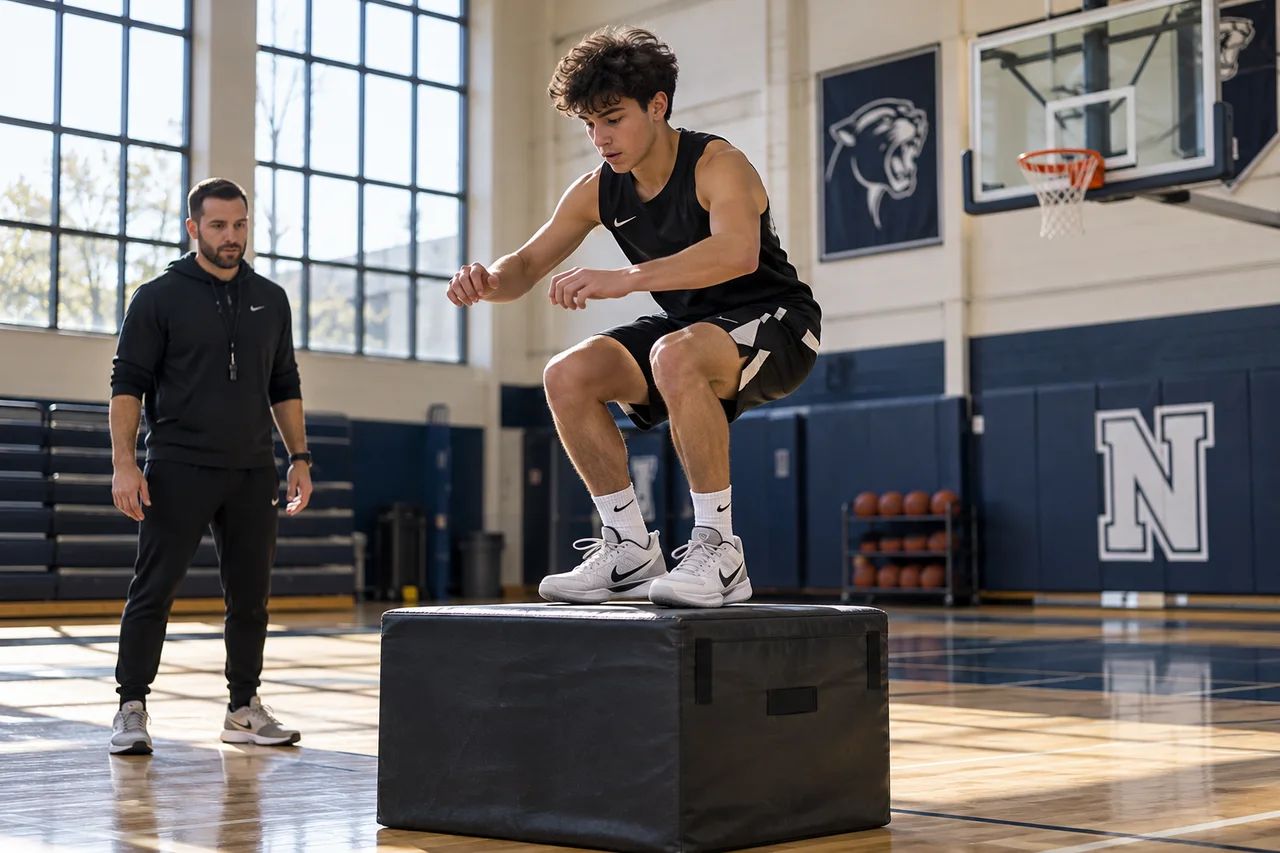
- Low box jumps. Jump onto a stable box or step at about knee height or lower, land softly, then step down. Jumping down off the box adds landing force without adding height.
- Lateral bounds. Jump sideways from one foot to the other and hold each landing, good for basketball and soccer movement.
Single-leg hops come only after two-foot landings are consistently clean. Depth jumps, where an athlete drops off a box and rebounds straight up, are an advanced exercise. Save them for older teens working with a qualified coach.
A sample 6-week jump plan
Volume is counted in foot contacts: each time the feet hit the ground in a jump drill counts as one. A systematic review of plyometric training in youth athletes suggested starting at about 50 to 60 foot contacts per session and building to no more than 80 to 120, two days a week with about 72 hours between sessions (Bedoya and colleagues, Journal of Strength and Conditioning Research). The plan below stays inside that range. Treat it as a starting point, and stay at the lower end for younger kids.
| Weeks | Focus | What to do | Foot contacts per session |
|---|---|---|---|
| 1 and 2 | Landing and strength | Snap-downs, low drop landings, bodyweight strength circuit | About 30 to 40 (landings only) |
| 3 and 4 | Low-level jumps | Pogo hops, squat jumps, broad jumps, plus strength | About 50 to 60 |
| 5 and 6 | Higher jumps and approach | Low box jumps, lateral bounds, running jumps with a two-step approach, plus strength | About 60 to 80 |
Do two sessions a week on non-consecutive days, which also fits the two to three days a week the international consensus recommends, each starting with a five-minute dynamic warm-up. When jumps get slower or landings get noisy, the set is over.
Measuring progress. Use a simple wall reach test every two weeks. Stand sideways to a wall and mark the highest point you can reach flat-footed. Then jump from a standstill and mark the highest touch. The gap between the two marks is the vertical jump. Write it down with the date, and expect small, uneven gains, especially during a growth spurt.
Common mistakes
- Jumping every day. Muscles and tendons adapt between sessions, not during them.
- Ankle weights. They change how a child lands and add stress to the knees and ankles.
- Boxes that are too high. A box a child has to tuck their knees to reach teaches a scrambling landing, not a higher jump.
- Training through pain or skipping the warm-up. Both are easy ways to turn a good plan into an injury.
- Piling it on top of a full sports schedule. For a busy kid, jump training should replace some volume, not just add more.
When to start in New Jersey
For high school basketball players, the calendar is set by the NJSIAA. Its winter quick chart lists November 30, 2026 as the first day of basketball practice for 2026-27, with an optional three-day tryout allowed on the Monday through Wednesday before Thanksgiving, November 23 to 25 this year (NJSIAA; dates are listed as tentative). Starting the six-week plan in late October finishes it around tryouts and the first practice. For spring sports, the winter months are the natural window.
If your child works with a private trainer, ask one question before any box comes out: can you film my child's landing and show me what you are looking for? A good trainer will happily point out the knees, hips, and feet, and will hold off on harder jumps until the landing is right.
If you would like help, compare private basketball coaches in New Jersey on Rite Coach by experience and the ages they train, then contact them directly. For ball skills to pair with this plan, see our guide to basketball drills for kids, and for choosing a format, private vs group sports training.
Frequently asked questions
How long does it take to jump higher?
Better technique can add height within a few weeks. Real strength gains take longer, usually a couple of months of consistent training, and growth spurts can hide progress for a while.
What age can kids start jump training?
Simple hopping and landing games suit young children. Structured jump training fits once a child can follow instructions and land with control, with harder exercises like depth jumps saved for older teens and a coach.
How often should kids do jump training?
Two sessions a week, a couple of days apart, is plenty. More is not better: jumps every day leave legs tired, not springy.