Softball pitching drills for beginners
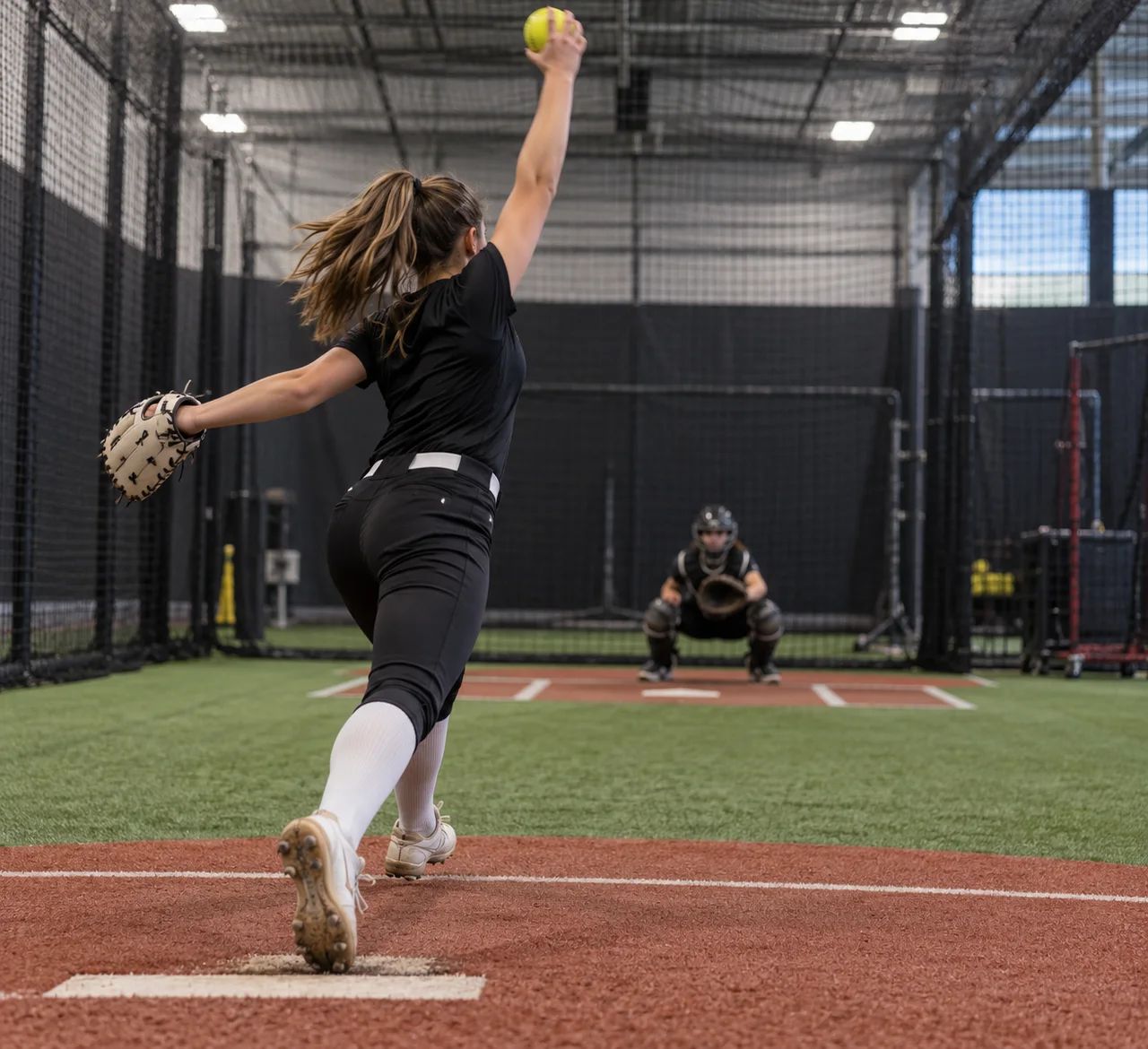
Every new softball pitcher goes through the same stage: a few pitches pop into the glove, the next one bounces, and the one after sails over the catcher's head. That is normal. The windmill pitch has a lot of moving parts, and beginners get better fastest when they learn those parts one at a time before putting them back together.
This guide covers the softball pitching drills that build the motion piece by piece, the pitching distance at each level, and the arm care rules that keep young pitchers healthy, plus a 15-minute routine to do at home.
How does the windmill pitch work?
Coaches usually break the pitch into six parts: presentation (on the rubber, facing the catcher), load (weight shifts back), stride (a hard drive off the rubber straight toward home), arm circle (a full circle past the ear, close to the body), release (the forearm brushes the hip and the wrist snaps the ball out), and follow-through (arm up and forward, balanced to field).
The key idea for a beginner: speed comes from the legs, not from swinging the arm harder. Picture the arm circle as a clock face seen from the side. The arm should pass 12, 3, 6 and 9 o'clock in one straight line, not swing wide around the body.
Warm-up and arm care come first
A common belief is that underhand pitching is easy on the arm. It is not. Researchers at Washington University School of Medicine studied more than 100 fastpitch pitchers ages 14 to 18 and found that about 40% had a shoulder or arm injury during the season. Their strength dropped over multi-day tournaments and did not fully recover between games (Washington University School of Medicine). The lead researcher noted that biomechanical studies show shoulder stress is very similar whether a pitcher throws overhand or underhand.
The American Orthopaedic Society for Sports Medicine lists shoulder tendinitis, back or neck pain, and elbow, forearm and wrist tendinitis as the most common overuse injuries for softball pitchers. Its STOP Sports Injuries tip sheet recommends:
- Warm up with stretching, running and easy, gradual throwing before pitching.
- Avoid pitching for more than one team with overlapping seasons, and don't play year-round.
- Don't pitch more than two days in a row until age 13, or more than three in a row after that.
- Don't pitch with pain, and see a doctor if the pain lasts a week.
The same sheet suggests maximum pitch counts by age, for example 65 pitches in a game for 10 to 12 year olds.
League rules vary. Little League Softball limits Major division pitchers to 12 innings a day, with a day of rest after 7 or more innings. High school softball under NFHS rules has no pitching limits at all (Little League and NFHS comparison), so parents and coaches have to do the counting.
Wrist snap and release drills
Start close to the catcher, with no stride and no full circle. These drills teach the release, which controls spin and accuracy.
Wrist snaps
Stand about 10 feet from a partner with the pitching elbow tucked against the side. Flip the ball forward using only the wrist, 15 to 20 times. The ball should spin cleanly, not wobble.
Brush drill
Start with the arm behind the body at about 9 o'clock. Bring it down so the forearm brushes the hip, and snap the ball out. The brush is a timing check that keeps the release point in the same place.
K drill
Stand in the stride position, glove-side foot forward, with the pitching arm straight up so the body forms a K. Bring the arm down through the back half of the circle, brush the hip and release.
Arm circle and leg drive drills
Once the release is consistent, back up and add the full circle, then the legs.
- Full circles and walk-throughs. Make full circles from the stride position, then take one walking step into the stride and pitch, so legs and arm work together.
- Wall or fence drill. Stand sideways about an arm's length from a fence and make slow full circles. If the hand hits the fence, the circle is drifting away from the body.
- Power line drill. Chalk a line from the middle of the rubber toward home. The stride foot lands on it every pitch. Landing to the side means throwing across the body.
- Stride marker. Put a flat marker where the stride foot should land. Beginners often step short, which kills leg drive. Move it out as the pitcher gets stronger.
A note on leaping and crow hops
Leg drive is where pitching rules come in. Since the 2024 season, NFHS rules for high school softball allow a pitcher to leave the ground with both feet, as long as the pivot foot is not replanted before the pitch (NFHS). Replanting the back foot and pushing off a second time, often called a crow hop, is still an illegal pitch. Little League Softball follows the same delivery rules as NFHS. Travel organizations publish their own rulebooks, so check yours before teaching an aggressive drive.
Accuracy drills and games
Speed gets attention, but accuracy wins games at the youth level. These drills turn location into a game.
- Four-quadrant targets. The catcher sets the glove high or low, inside or outside. Call a spot before each pitch and keep score.
- Three strikes before three balls. The round ends only when the pitcher throws three strikes before three balls. It teaches pitchers to reset after a miss.
Practice from the distance your child will pitch in games:
| Level | Pitching distance | Source |
|---|---|---|
| USA Softball 10U | 35 feet | USA Softball |
| Little League Majors | 40 feet | Little League |
| 12U and 14U travel | 40 or 43 feet, set by the organization | Your league rules |
| Little League Junior and Senior | 43 feet | Little League |
| High school (NFHS) | 43 feet | NFHS |
| USA Softball 18U (girls) | 43 feet | USA Softball |
Sources: USA Softball and the Little League and NFHS comparison above. Middle age groups vary, so confirm with your league.
Common beginner mistakes
- Stepping off the power line, which throws pitches inside or outside.
- A bent elbow in the circle, which sends pitches high or wide. The wall drill fixes it.
- Releasing too early or late. Early goes high, late goes in the dirt. Go back to the brush drill.
- Arm only, no legs, which costs speed and tires the arm.
A 15-minute home routine
- Warm-up, 4 minutes. Arm circles, light jogging and easy catch.
- Wrist snaps and brush drill, 3 minutes. About 15 of each from a short distance.
- K drill and walk-throughs, 3 minutes. About 10 of each, building toward a full pitch.
- Power line pitches, 3 minutes. Full pitches at the game distance, checking the landing foot.
- Accuracy game, 2 minutes. Three strikes before three balls.
Two or three times a week is plenty for a beginner, with days off after games.
Timing it to the New Jersey season
High school softball is an NJSIAA spring sport. The association's spring quick chart lists March 8, 2027 as the first day of softball practice for 2026-27, with games allowed from March 15 (NJSIAA; all dates are listed as tentative). That makes late fall and winter the time to rebuild mechanics, often at indoor facilities, before the volume of the season starts.
The Washington University researchers found most injuries came in the first six weeks of the season, possibly because pitchers ramped up too quickly, so a gradual winter build-up also protects the arm.
If your child works with a pitching coach, ask one question: how do you track pitch counts and rest days for a pitcher on more than one team? A good coach will have a clear answer and will ask about the travel and school schedules. For more, see our guide on how to choose a youth sports coach, and our comparison of private and group training.
When you are ready, compare softball coaches in New Jersey on Rite Coach by experience and the ages they train, then contact them directly. On town pages with only a few coaches listed, you can send one request and we will pass it to coaches near you.
Frequently asked questions
What age should a softball pitcher start pitching lessons?
Many start around 8 to 10, when they can follow multi-step instructions. Keep early sessions short and fun.
How many days a week should a young pitcher practice?
Two or three short sessions a week is enough for a beginner, with no more than two pitching days in a row until age 13.
Is windmill pitching bad for the arm?
Not with good mechanics and sensible limits. But shoulder stress is similar to overhand throwing, so pitch counts and rest matter as much as in baseball.
Looking for a private softball coach?
Rite Coach lists coaches across New Jersey.