Basketball defense drills for youth players
In most youth basketball games, the easy baskets do not come from great moves. They come from a defender who stood up straight, reached for the ball, or turned to watch a pass and lost their player. None of that is about size. It is about habits, which drills build.
This guide covers basketball defense drills for youth players, from stance and slides to closeouts, help side and boxing out, with what to teach at each age and the mistakes to fix. For drills across every skill, start with our main guide to basketball drills for kids. If you want someone to watch your child defend and correct it in person, you can compare basketball coaches in New Jersey on Rite Coach.
What makes a good youth defender?
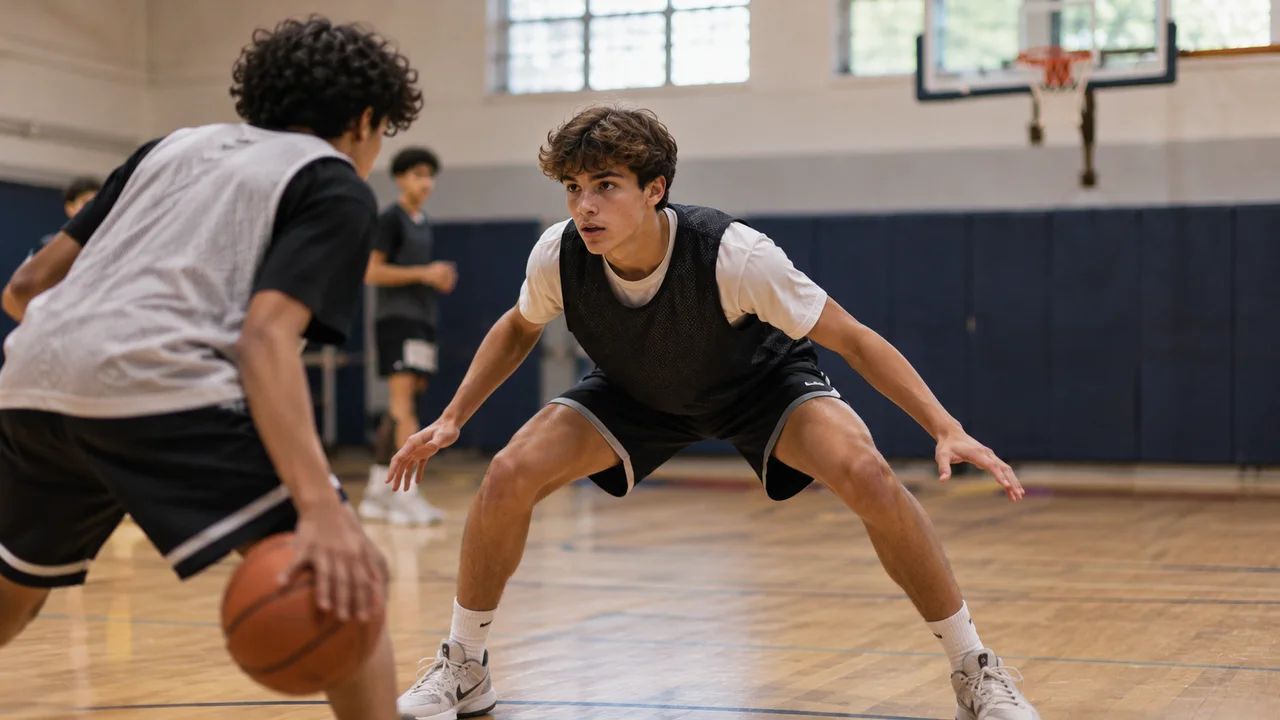
A good young defender does four things: stays in a low stance, keeps their body between their player and the basket, works hard every possession, and talks.
Defense is also the most teachable part of the game. A shorter, slower player who slides well and never quits on a possession will guard most kids their age. That is why the drills below spend so much time on feet and so little on hands.
The stance itself is simple. USA Basketball's Youth Development Guidebook describes it as feet wider than the shoulders, a slight knee bend, back straight, chin up and hands above the waist. Teach that before anything else, and come back to it in every drill.
Footwork drills
1. Stance holds
Players get into a defensive stance and hold it for 20 to 30 seconds while the coach checks each one: feet wide, hips low, weight on the balls of the feet, hands active. Add short bursts of quick feet ("chop") on a whistle.
2. Zig-zag slides
Players start in the corner and slide diagonally to the elbow area, then drop step and slide diagonally the other way, all the way up the court. The rules: lead with the foot nearest the direction you are going, push off the other, and never bring the feet together or cross them. Start without a ball. When the footwork is clean, add an offensive player who dribbles at half speed in a zig-zag while the defender stays in front.
3. Lane slides with a drop step
Players slide from one side of the lane to the other, touching the line each time, for 20 to 30 seconds. On the coach's call, they drop step (swing the back foot open) and change direction., the same move a defender needs when a dribbler gets a step past them.
4. Mirror drill
Two players face each other a few feet apart. The leader slides left and right, steps forward and back. The defender copies every move without crossing their feet. Switch roles every 20 seconds.
On-ball drills
5. Closeouts
A closeout is how a defender runs at a player who just caught the ball without getting beaten by a dribble or fouling a shooter. The cues follow USA Basketball's guidebook: sprint the first three quarters of the distance, then chop the feet in short, quick steps, sit the weight back, and raise a hand high to bother the shot. A defender who flies past the shooter has given up a layup or a foul. Line players up on the baseline and have them close out to a coach or partner at the wing, then slide to stop one dribble either way.
6. One-on-one contain from the wing
An offensive player starts on the wing with the ball. The defender's only job is to keep them out of the lane for three or four dribbles, hands back, no reaching. The defender scores a point for every possession that stays out of the paint, which teaches that staying in front is a win even without a steal.
7. Deny the wing
When the defender's player is one pass away from the ball, the defender should make that pass hard. The defender stands between their player and the ball, with a hand and foot in the passing lane, and works to keep the wing from catching it. Run it with a coach at the top as the passer. When the wing cuts back door toward the basket, the defender opens up and turns to the ball.
Team defense drills
8. The shell drill
The shell drill is the standard way to teach team defense. Four offensive players stand around the three-point line and pass the ball around; four defenders adjust on every pass. The defender on the ball pressures it. Defenders one pass away deny. Defenders two passes away sink into help position, one step off the line between the ball and their player, ready to stop a drive.
Start with passes only, freezing after each pass to check positions. Then allow drives, so helpers learn to stop the ball and recover. Finish live.
9. Box out and rebound
A coach shoots from the top. Each defender finds their player, makes contact, turns to put their back on the offensive player, and holds their ground before going to get the ball. The rule is "find, hit, get": find your player, hit them first, then go get the rebound. A defensive possession is not over until someone has the ball.
For keeping legs fresh enough to defend late in games, see our basketball conditioning drills.
What should kids work on by age?
The NBA and USA Basketball youth guidelines recommend no zone defenses for ages 7 to 8 and 9 to 11, so younger players learn to guard a player rather than stand in an area (NBA.com). USA Basketball's guidebook also waits to introduce help side defense until players can guard one player on their own. The table below follows that order, though skill matters more than age.
| Age | Focus | Drills to use |
|---|---|---|
| 8 to 10 | Stance, slides, guarding one player (man-to-man) | Stance holds, zig-zag slides, mirror drill |
| 11 to 13 | Closeouts, denial, help side, boxing out | Closeouts, deny the wing, shell drill, box out |
| 14 and up | Rotations, switching, defending screens, scouting tendencies | Live shell drill, contain drills against a scout |
Zones are not bad defense, just a poor way to learn it: a young player can stand in one spot all game without learning to slide, deny or close out.
Common defensive mistakes
Reaching. Grabbing for the ball puts a defender off balance and usually ends in a foul or a layup. Keep the hands active but the chest in front.
Crossing the feet. A defender who crosses over cannot change direction. Slide, do not run sideways.
Standing up. Kids rise out of their stance as they tire. Stance holds and conditioning fix most of this.
Watching the ball. Defenders away from the ball turn their heads and lose their player on a cut. Teach them to point one hand at the ball and one at their player.
Not talking. "Ball," "help," "shot." Quiet defenses get screened and give up easy cuts.
Defense and the New Jersey winter season
For New Jersey high schools, the NJSIAA's tentative 2026 to 2027 calendar has basketball practice opening November 30, with games allowed from December 7, and an optional three-day tryout window on the Monday to Wednesday before Thanksgiving (NJSIAA winter quick chart). Town rec and travel leagues usually start around the same time. Many of them set their own rules for younger divisions on pressing, zones and where the defense can pick up, so check your league's rules before the first game rather than assuming they match the national guidelines.
If your child works with a private trainer, try this at the first session: ask, "Which one defensive habit can we fix in a single session?" A good trainer will watch a few possessions and name something specific, such as standing up out of the stance or reaching on the drive, then give your child one drill to do at home. For how trainers fit this into a full session, see our basketball practice plan.
You can compare private basketball coaches in New Jersey on Rite Coach by experience and the ages they train, then contact them directly. For what shapes the cost, see our guide to how much private basketball lessons cost in New Jersey.
Frequently asked questions
What is the best basketball defense drill for beginners?
Stance holds and zig-zag slides. They teach the two things every other defensive skill depends on: a low, balanced stance and sliding without crossing the feet.
Should youth basketball teams play zone defense?
The NBA and USA Basketball youth guidelines recommend no zone defense through age 11. Players who learn man-to-man first build the footwork and habits a zone needs later.
How can my child get better at defense at home?
Ten minutes of stance holds, lane slides and mirror work with a sibling or parent, a few times a week. Defense is mostly footwork and effort, and both improve with reps.
Looking for a private basketball coach?
Rite Coach lists coaches across New Jersey.